We keep in mind that when a mark, or a portion of a mark, is conceptually weak, it is entitled to a narrow scope of protection. In other words, when a business adopts a mark incorporating a weak term, it assumes the risk that competitors may also use that term.
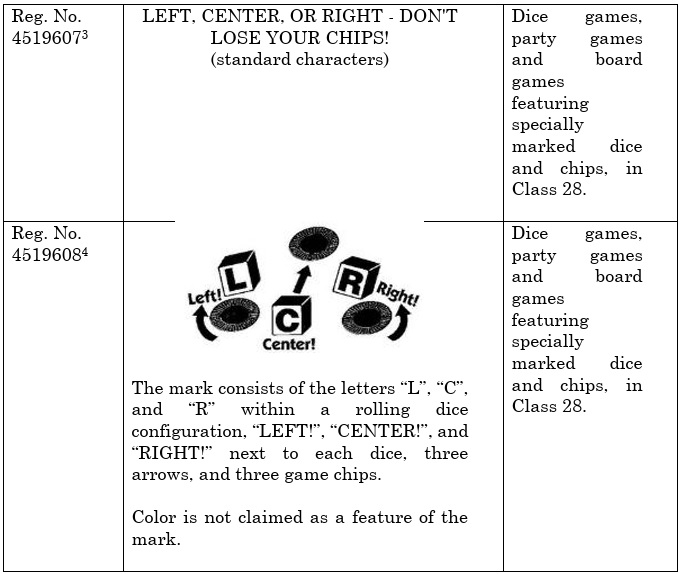
As stated, Respondent’s mark is LEFT RIGHT MIDDLE and this combination of words is at least highly suggestive of how the dice game is played. Of the eight words in Petitioner’s mark LEFT, CENTER, OR RIGHT – DON’T LOSE YOUR CHIPS!, Respondent’s mark shares only the two descriptive terms LEFT and RIGHT, which do not appear in the same order (adjacent) as they do in Petitioner’s mark (separated by the term CENTER).
USPTO >TTAB > George & Company LLC v. P & P Imports LLC, Cancellation No. 92082259 (August 4, 2025)
□ keep in mind:留意する、心に留めておく、覚えておく
□ be entitled to ~:~する資格(権利・権限)がある
□ narrow:狭い、限られた、細い
□ scope of protection:保護範囲、権利の及ぶ範囲
□ incorporate:組み込む、含む
□ adjacent:隣接した、近くの
ダイスゲームにおける「LEFT RIGHT MIDDLE」の使用は、「LEFT CENTER RIGHT(図形付)」商標と混同のおそれはあるか?
商標の全部又は一部が、概念上、識別力が弱い場合、その保護範囲は狭くなることを忘れてはならない。つまり、事業者が識別力の弱い語を含む商標を採択すると、競合他社も当該語を使用するリスクを容認することになる。
上記のとおり、被請求人の商標は「LEFT RIGHT MIDDLE」であり、当該語の組み合わせは、少なくとも、ダイスゲームの遊び方を強く連想させる。請求人商標「LEFT, CENTER, OR RIGHT – DON’T LOSE YOUR CHIPS!」を構成する8つの語のうち、被請求人の商標は、「LEFT」及び「RIGHT」の2つの記述的な語のみを共有しているが、これらについても、請求人商標では「CENTER」という語で分離されているのに対し、被申立人商標は隣接しており、並び方が異なる。

when a mark, or a portion of a mark, is conceptually weak, it is entitled to a narrow scope of protection.
商標の実務では、商標を構成する要素(文字や図形)が、商標としての機能(特定の事業者の出所表示機能)を発揮するか否かを判断する指標として、「自他識別力」という概念を用い、自他識別力の有無(程度)を、「強(strong)・弱(weak)」で表します。商標の自他識別力が強ければ、権利範囲は広くなり、逆に、自他識別力が弱ければ、権利範囲は狭くなります(a narrow scope of protection)。このため、権利範囲の広い(=他社の容易に模倣されたくない)商標を狙うのであれば、識別力の強い要素(文字や図形)を選ぶことが必要です。