
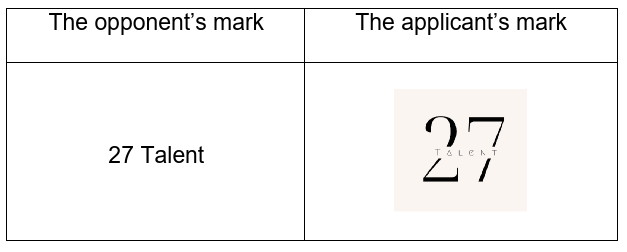
Taking the above into account, I am of the view that the differences between the marks are likely to be overlooked and are therefore likely to be mistakenly recalled or misremembered as each other, particularly when factoring in the principle of imperfect recollection. Whilst I bear in mind that some of the services are similar to only a low degree, I consider that the effect of the interdependency principle is such that there will still be confusion for these services. Consequently, I find there to be a likelihood of direct confusion. Even if the differing stylisation between the marks is recalled, and the applicant’s mark is perceived as ‘Talent 27’ rather than ‘27 Talent’, I find that this will simply be put down to an alternative mark being used by the same or economically linked undertaking.
UKIPO > Opposition > 23 March 2026, O/0241/26
□ take ~ into account:~を考慮[考え・計算・勘定]に入れる
□ overlook:見逃す、見落とす
□ recall:思い出す、思い起こす
□ factor in:~を考慮[計算]に入れる、~を織り込む
□ put A down to B:AをBのせいにする、Aの原因をBに帰する
出願商標は、「Talent 27」というより、「27 Talent」と認識される
上記を踏まえると、両商標のの差異点は見落とされやすく、特に、人の記憶が不確かなことを考慮すれば、互いに誤って想起されたり、誤って記憶されたりする可能性が高いものと考えられる。一部の役務については類似性が低いものの、「相互依存の原則」の作用により、当該役務においても依然として混同が起こる得る。したがって、直接的な出所混同のおそれが認められる。たとえ、両商標の図案化の相違が思い起こされ、本願商標が「27 Talent」ではなく、「Talent 27」として認識されるとしても、それは単に、同一又は経済的に繋がりのある事業者が別の商標を使用しているに過ぎない。

particularly when factoring in the principle of imperfect recollection
「imperfect recollection」は、民事・刑事裁判での証拠収集手続において、証人から得た証言の評価が議論となる場面で、頻繁に出てくる法律用語です。商標では、商標の類否や出所混同のおそれに関して、需要者の認識(注意力)が議論となる場合で出てきます。人の記憶は、その人の記憶力や状況によって異なり、曖昧(不完全)なことの方が多いです。この曖昧さ・不確かさが商標の勘違いを招くことにつながります。