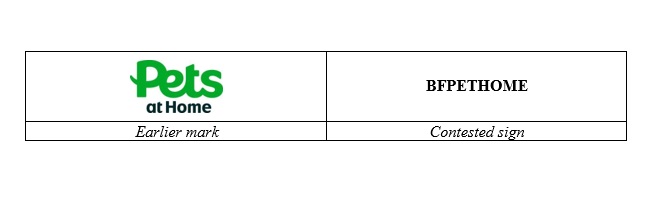
The earlier mark is a figurative mark consisting of the verbal element ‘Pets’ in a rather stylised bold green typeface. Below this, in the centre, are the verbal elements ‘at Home’ in lower case apart from the letter ‘H’, and in a significantly smaller dark green typeface.
According to the case-law, with the exception of certain terms forming part of basic English vocabulary, it cannot be assumed that English terms are widely known in the European Union.
Although it is true that an understanding of a foreign language may not, in general, be presumed, the fact remains that if the English terms have an equivalent in the language of the non-English-speaking public and a link may be established by that public between those terms and their translation into the language concerned, then that public must be held to understand their meaning.
□ typeface:書体、字体
□ in general:一般に、概して
□ presume:仮定する、推測する、思う
□ equivalent:同等のもの、相当するもの
「Pets at Home」と「BE’PETHOME」は、出所混同のおそれなし - 1
先行商標は、太字で緑色の書体により、やや図案化して書された「Pets」の文字からなる図形商標である。当該文字の下中央には、「H」以外が小文字で書された「at Home」の文字が、かなり小さく、濃い緑色の書体で配置されている。
判例法によれば、基本的な英語の語彙に該当する特定の語を除き、英語が欧州連合域内で広く認知されているとみなすことはできない。
一般に、外国語は理解されるものと推定できないとしても、ある英語と同等の語句が、非英語圏の公衆が話す言語に存在し、且つ、公衆がそれらの用語と自国の言語に翻訳したものとを関連付けることができる場合、関連公衆は、それらの意味を理解しているものと言える。

According to the case-law, it cannot be assumed that English terms are widely known in the European Union.
我々日本人からすれば、英語はヨーロッパで広く使われており、理解されているように思いますが、実際は、違うようです。最初、この判示内容を見たときは、目を疑いましたが、英国が離脱した今となっては、EU領域内では、フランス語、ドイツ語、スペイン語、イタリア語等々、確かに色々な言語が存在します。我々が思っている以上に、EUは歴史的にも、政治的にも、経済的にも、複雑であることを実感します。