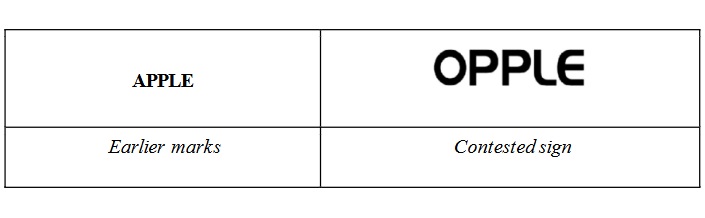
In any case, even if the pronunciation of the beginning of the signs at issue differs on account of letters ‘A’ and ‘O’, the signs have the sequence of letters ‘P’, ‘P’, ‘L’ and ‘E’ in common. Consequently, the signs coincide in the pronunciation of the sequence of letters ‘P’, ‘P’, ‘L’ and ‘E’, which constitute four out of the five letters in both signs. Irrespective of the different pronunciation rules in different parts of the relevant territory, namely the European Union, the pronunciation of those signs coincides in the group of letters ‘PPLE’. Thus, even if, at least for a part of the relevant public, , the pronunciation of the group of letters ‘PPLE’, which is common to those signs, is on its own liable to create a strong phonetic similarity between those signs.
EUIPO > Opposition > Fourth Board of Appeal > case R 40/2025-4 (14 October, 2025)
□ in any case:とにかく、どうあろうと、いずれにせよ
□ on account of:~のために、~の理由で
□ irrespective of:~に関係なく、~にかかわりなく、~にかまわず
□ preclude:排除する、不可能にする、起こらないようにする
□ be liable to:~しがちである、~するおそれがある、責任を負う
APPLEとOPPLEの外観及び称呼上の類似性の程度は、少なくとも平均レベル - 5
いずれにせよ、「A」と「O」の文字によって両商標の語頭音が異なるとしても、両商標は「P」「P」「L」「E」の文字列が共通している。そうすると、両商標は、全5文字中4文字を占める、「P」「P」「L」「E」の文字列の発音が一致する。対象地域(すなわち欧州連合)内の地域間で発音のルールが異なるとしても、両商標の称呼は、「PPLE」の文字部分において一致する。したがって、たとえ、語頭文字「A」と「O」の発音により、少なくとも一部の関連公衆にとって、両商標の称呼が同一でないとしても、共通する「PPLE」の文字部分の発音は、それ自体、両商標の称呼の類似性を高めるものである。

the pronunciation of the initial letters ‘A’ and ‘O’ precludes the phonetic identity of the signs at issue
称呼の類否判断において、語頭音は、とても重視されます。最初の音が異なれば、違う語と認識される可能性が高まるからです。「おにわ」と「はにわ」。「たかいもの」と「わかいもの」。また、語頭音の母音(a,i,u,e,o)が異なるかも影響します。ざっくりですが、日本では、5音以下で語頭音が異なれば、称呼非類似と判断される可能性は高く、6音以上でも、語頭音の母音が異なれば、称呼非類似と判断される可能性があります。